Research
Complex fluids, fluid–structure interactions, and computational dynamics
My research lies at the intersection of applied mathematics, fluid mechanics, and scientific computing. I use mathematical models, numerical simulation, and collaborations with experimentalists to investigate how fluids behave when their dynamics are shaped by elasticity, complex microstructure, and interactions with moving bodies.
A recurring theme is the emergence of unexpected dynamics from relatively simple mathematical models: instabilities, coherent structures, periodic motion, and transitions to irregular behavior.
Complex fluids and nonlinear dynamics
Even in the absence of inertia, viscoelastic fluids can exhibit remarkably complicated dynamics. Elastic stresses interact with fluid motion, producing instabilities, coherent structures, and sustained time-dependent flow.
I study these phenomena using numerical simulations and mathematical models, including the Oldroyd-B equations. Recent work explores periodic and more complicated dynamics in model flows, including Kolmogorov flow and the four-roll mill.
A central question is how relatively simple constitutive models give rise to complex spatiotemporal behavior.
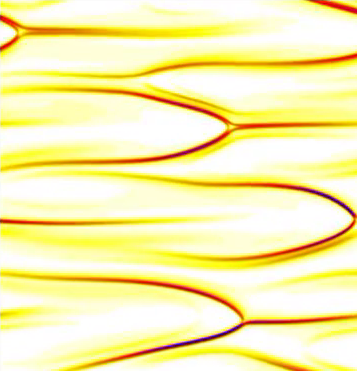
Structures in a viscoelastic flow simulation.
Elastoviscoplastic fluids
Many materials combine elastic deformation, viscous flow, and yielding. Examples include gels, pastes, and suspensions, which can behave like solids under some conditions and flow like liquids under others.
My research examines how plasticity changes the dynamics of viscoelastic flows, using mathematical models such as the Saramito elastoviscoplastic model.
An especially interesting question is how yielding can both suppress and reorganize flow instabilities, leading to nontrivial transitions between distinct dynamical regimes.
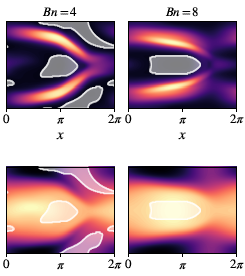
Flow structures in elastoviscoplastic models.
Swimming and fluid–structure interactions
How does the rheology of a surrounding fluid influence the motion of a swimmer?
I study the interaction between deforming bodies and complex fluids, including sperm swimming in Newtonian and viscoelastic environments. This work connects mathematical modeling and computation with experimental observations of swimming kinematics.
These problems reveal how the interplay between fluid stresses, flexible structures, and prescribed or internally generated motion influences locomotion.
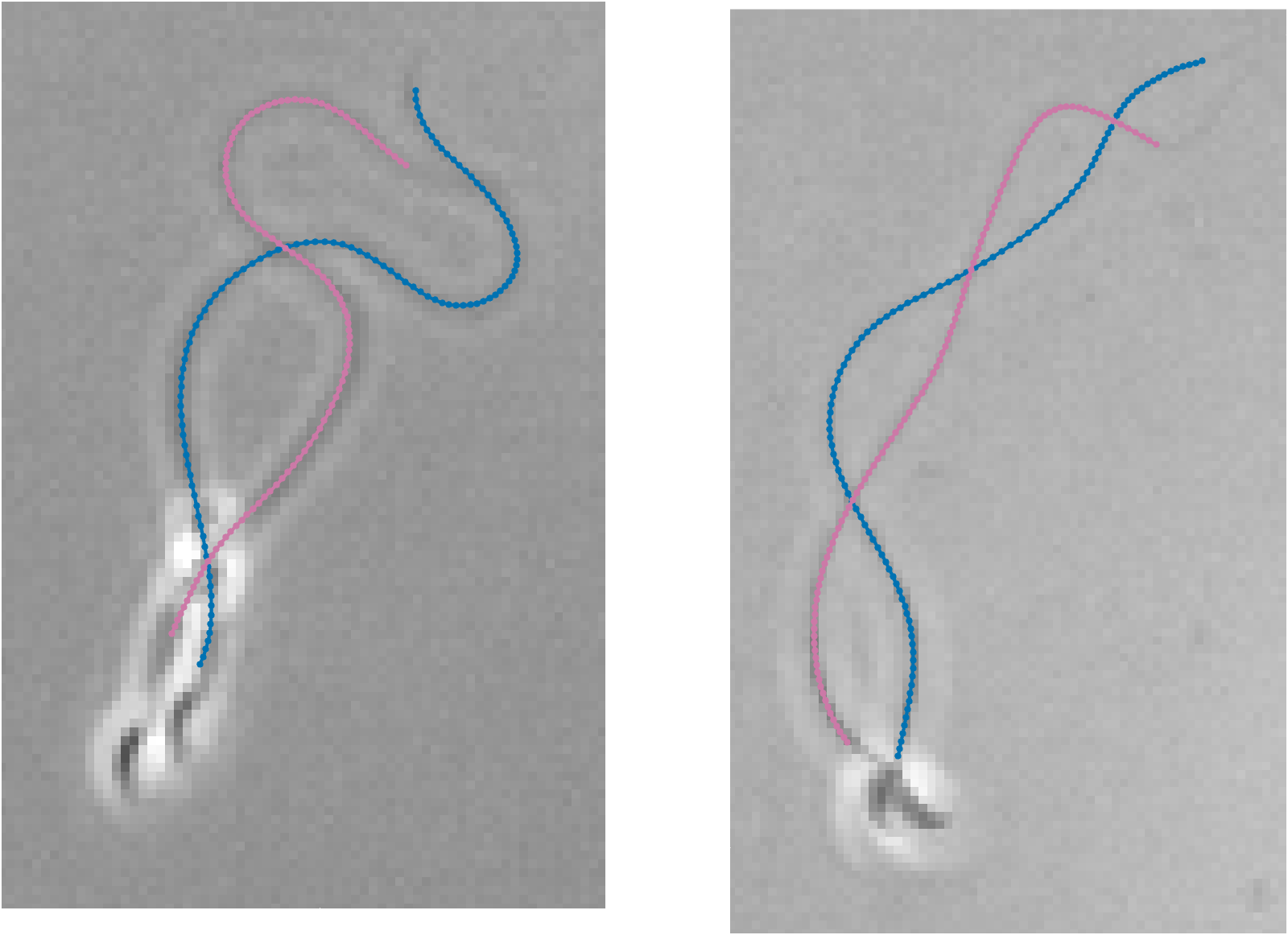
Experimental sperm flagellar shapes and reconstructed centerlines.
Learning to swim: reinforcement learning and cilia
A newer direction in my research uses reinforcement learning to explore locomotion strategies in viscous fluids.
Beginning with simple bead-based models of cilia, we compare learned strokes with computationally determined optimal solutions. These small systems provide useful benchmarks for understanding how learning algorithms discover effective periodic motion.
The longer-term goal is to extend these ideas to more flexible swimmers and investigate how geometry, hydrodynamic interactions, and fluid rheology shape optimal locomotion.
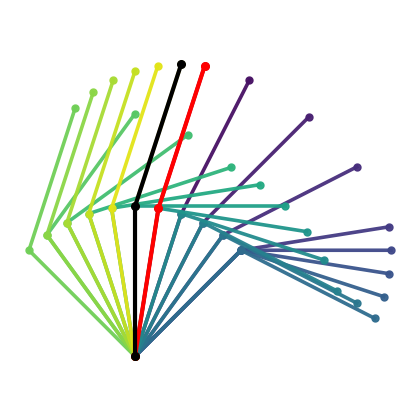
Reconstructed strokes from a computational cilium model.
Research publications
Selected publications and preprints associated with these topics are available on the Publications page.